
Certified Hard Drive & Data Destruction Services in Houston
This is our main data destruction guide. Use the related guides below to compare methods, standards, and data-security risks.
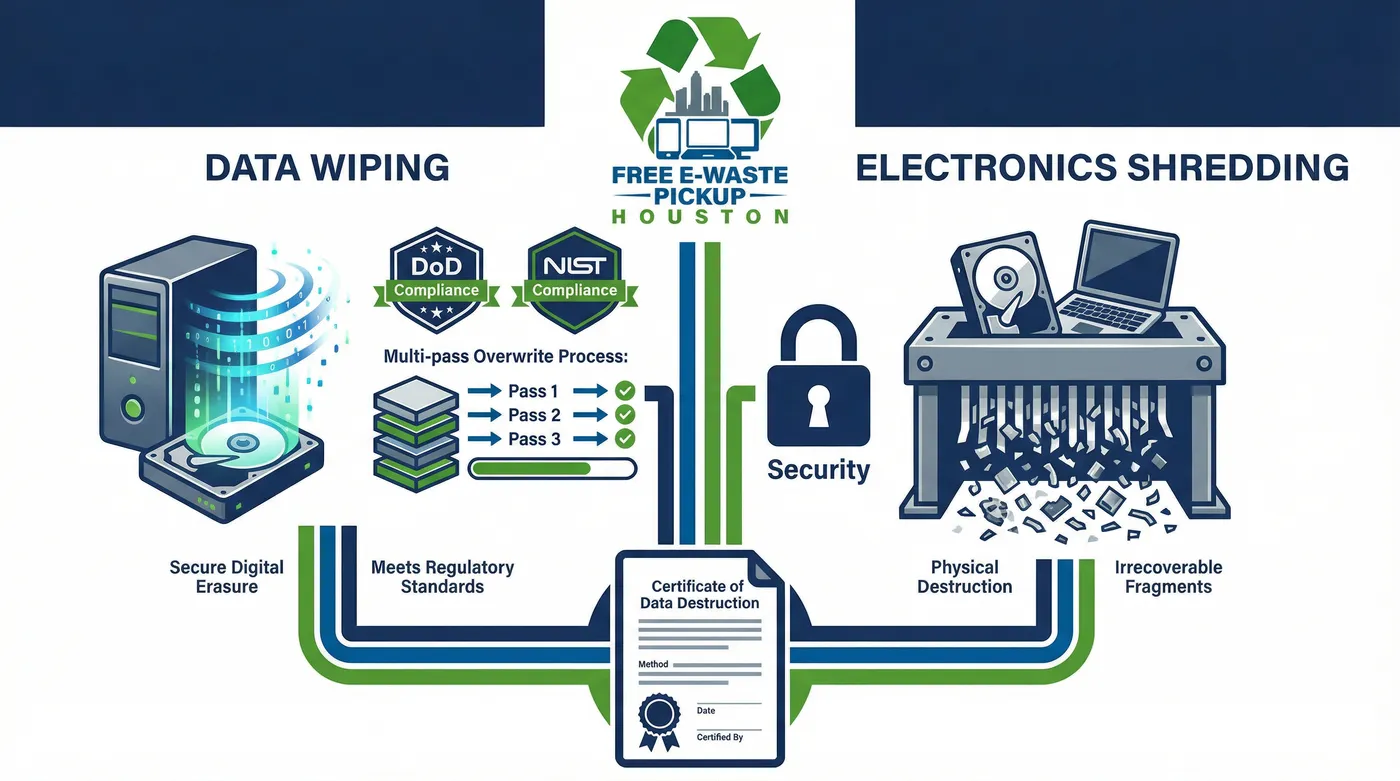
In the digital age, data is the lifeblood of every Houston business. From the financial institutions in the Galleria area to the healthcare providers in the Texas Medical Center, organizations amass vast quantities of sensitive information. This data resides on hard drives, solid-state drives (SSDs), servers, and mobile devices. When this hardware reaches the end of its lifecycle, the data it contains does not simply vanish. It remains a potent liability until it is permanently and verifiably destroyed.
Data destruction is the process of rendering data completely unrecoverable, ensuring that it cannot be accessed or reconstructed by any known means. For Houston businesses, certified data destruction is not merely a best practice; it is a fundamental requirement for risk management, regulatory compliance, and protecting corporate reputation.
This comprehensive guide explores the critical importance of data destruction, the various methods available, the regulatory landscape in Texas, and how to choose a certified data destruction partner in Houston. By understanding these elements, businesses can safeguard their most valuable asset - their data - from the moment it is created until the hardware is finally retired.
The Anatomy of a Data Breach
To understand the necessity of data destruction, one must first understand the anatomy of a data breach resulting from improper IT asset disposal. When a business upgrades its computers or servers, the old equipment is often stockpiled in a storage room or handed off to an uncertified recycler. If the data on these devices is not properly sanitized, it remains accessible to anyone who acquires the hardware.
Cybercriminals are well aware of this vulnerability. They actively seek out discarded electronics, purchasing them from secondary markets or even scavenging them from dumpsters. Once they have physical possession of a hard drive, they can use sophisticated data recovery tools to extract sensitive information, even if the files were "deleted" or the drive was formatted.
The consequences of such a breach are severe and multifaceted:
Financial Devastation
The financial impact of a data breach is immediate and long-lasting. According to the Ponemon Institute's Cost of a Data Breach Report, the average cost of a breach runs into the millions of dollars. Our in-depth breakdown of the true cost of a data breach for Houston businesses covers exactly where those costs accumulate. These costs include:
- Regulatory Fines: Non-compliance with data protection laws can result in massive penalties.
- Legal Fees and Settlements: Businesses often face class-action lawsuits from affected customers or employees.
- Incident Response: Investigating the breach, notifying victims, and providing credit monitoring services are incredibly expensive.
- Lost Business: The operational disruption and loss of customer trust directly impact revenue.
Reputational Damage
A company's reputation is built over years but can be destroyed in an instant. When a data breach occurs, the public perception of the organization plummets. Customers lose confidence in the company's ability to protect their personal information, leading to customer churn and a tarnished brand image that can take years to rebuild.
Intellectual Property Theft
For many Houston businesses, particularly in the energy, technology, and manufacturing sectors, intellectual property (IP) is their most valuable asset. If proprietary designs, trade secrets, or strategic plans are recovered from a discarded hard drive, competitors can gain an unfair advantage, potentially devastating the business.
The Illusion of "Deleting" Data
A common and dangerous misconception is that deleting files or formatting a hard drive permanently removes the data. This is fundamentally incorrect.
When you delete a file in a standard operating system, the computer does not actually erase the data. Instead, it simply removes the pointer to the file in the file system's directory, marking the space as available for new data to be written. Until that space is overwritten, the original data remains intact on the physical disk and can be easily recovered using widely available, inexpensive software.
Similarly, formatting a drive (performing a "quick format") only creates a new, empty file system directory. The underlying data is still present and recoverable. To truly destroy data, specialized methods must be employed that either overwrite the data completely or physically destroy the storage media.
Methods of Certified Data Destruction
There are two primary methods for achieving certified data destruction: data wiping (sanitization) and physical destruction (shredding). The choice between the two depends on the organization's security requirements, the type of storage media, and the desired outcome for the hardware. For a detailed side-by-side comparison, see our guide on hard drive shredding vs. data wiping for Houston corporate offices.
1. Data Wiping (Sanitization)
Data wiping involves using specialized, enterprise-grade software to overwrite the entire storage device with random characters (zeros and ones). This process ensures that every sector of the drive is overwritten, rendering the original data completely unrecoverable.
The NIST 800-88 Standard: The gold standard for data wiping is the National Institute of Standards and Technology (NIST) Special Publication 800-88. This comprehensive guideline defines the protocols for clearing, purging, and destroying data across various media types. A certified data destruction provider will strictly adhere to NIST 800-88 standards, ensuring that the wiping process is rigorous and verifiable. For a technical comparison of available standards, see our guide on NIST 800-88 vs. DoD 5220.22-M data destruction standards.
Advantages of Data Wiping:
- Environmental Sustainability: The primary advantage of data wiping is that it leaves the physical hard drive intact and functional. This allows the drive (and the computer it belongs to) to be refurbished and reused, supporting a circular economy and keeping electronic waste out of landfills.
- Cost-Effectiveness: Because the hardware retains its value, data wiping is often a more cost-effective solution for IT asset disposition.
Challenges with SSDs: It is important to note that data wiping is more complex for Solid State Drives (SSDs) than for traditional Hard Disk Drives (HDDs). SSDs use wear-leveling algorithms that can hide data from standard wiping software. Therefore, specialized wiping tools designed specifically for SSDs must be used to ensure complete sanitization.
2. Physical Destruction (Hard Drive Shredding)
Physical destruction is the most absolute method of data destruction. It involves using industrial-grade shredders to physically grind the storage media into tiny, unrecognizable fragments.
The Shredding Process: Hard drives, SSDs, magnetic tapes, and optical media are fed into a shredder, which uses powerful interlocking blades to tear the devices apart. The resulting fragments are typically less than an inch in size, making it physically impossible to reconstruct the drive or recover any data.
Advantages of Physical Destruction:
- Absolute Certainty: Shredding provides the highest level of assurance that data is destroyed. It is often mandated by government agencies, defense contractors, and organizations with the most stringent security policies.
- Visual Verification: The physical destruction of the drive provides immediate, visual confirmation that the data is gone.
Disadvantages of Physical Destruction:
- Environmental Impact: Shredding destroys the hardware, meaning it cannot be reused. The fragments can only be recycled for their raw materials (metals and plastics), which is less environmentally sustainable than refurbishing the device.
| Factor | Data Wiping | Physical Shredding |
|---|---|---|
| Security level | Very high (NIST 800-88 verified) | Absolute (physically unrecoverable) |
| Hardware outcome | Device intact and reusable | Device permanently destroyed |
| Best for | Functional HDDs, most SSDs, high volume | Damaged drives, highest-security mandates |
| Environmental impact | Lower - hardware can be refurbished | Higher - hardware becomes scrap |
| Verification | Software audit log + certificate | Visual confirmation + certificate |
The Regulatory Landscape in Texas
Houston businesses must navigate a complex web of federal and state regulations regarding data protection and disposal. Failure to comply with these laws can result in severe penalties. Our dedicated 2026 Texas e-waste compliance guide covers the full legal landscape in detail.
Federal Regulations
- Health Insurance Portability and Accountability Act (HIPAA): Healthcare providers, insurers, and their business associates must safeguard Protected Health Information (PHI). HIPAA's Security Rule explicitly requires the implementation of policies and procedures to address the final disposition of electronic PHI and the hardware on which it is stored.
- Gramm-Leach-Bliley Act (GLBA): Financial institutions must protect consumers' personal financial information. The GLBA Safeguards Rule requires the secure disposal of customer information.
- Fair and Accurate Credit Transactions Act (FACTA): Any business that maintains consumer information derived from credit reports must properly dispose of such information to protect against unauthorized access.
Texas State Regulations
- Texas Identity Theft Enforcement and Protection Act (Business and Commerce Code, Chapter 521): This law requires businesses to implement and maintain reasonable procedures to protect sensitive personal information from unlawful use or disclosure. Crucially, it mandates that businesses must destroy or arrange for the destruction of customer records containing sensitive personal information when the business no longer needs to retain the records. Destruction must be done by shredding, erasing, or otherwise modifying the sensitive personal information to make it unreadable or undecipherable.
The Importance of a Certificate of Data Destruction
Regardless of whether a business chooses data wiping or physical shredding, the process is not complete without a Certificate of Data Destruction (CoD).
A CoD is a formal, legally recognized document provided by a certified IT Asset Disposition (ITAD) company. It serves as proof that the data on specific devices was securely and permanently destroyed according to recognized industry standards (such as NIST 800-88).
A comprehensive CoD should include:
- The date and location of the destruction.
- The method of destruction used (e.g., NIST 800-88 wipe, physical shredding).
- The make, model, and serial number of each processed hard drive or device.
- The signature of the technician who performed or verified the destruction.
Why the CoD is Essential:
- Audit Defense: In the event of a compliance audit (e.g., HIPAA, GLBA), the CoD is your primary evidence that you have met the regulatory requirements for data disposal.
- Liability Protection: If a data breach is alleged, the CoD provides a documented chain of custody, demonstrating that your organization took the necessary steps to destroy the data, thereby protecting you from liability.
- Peace of Mind: It provides tangible assurance to stakeholders, clients, and management that data security protocols were followed.
Choosing a Certified Data Destruction Partner in Houston
Given the high stakes involved, selecting the right data destruction partner is a critical decision for any Houston business. You cannot simply hand your hard drives to the lowest bidder; you must ensure they have the expertise, certifications, and processes to guarantee security.
Key Criteria for Selection:
- Industry Certifications: Look for providers that hold recognized certifications, such as R2 (Responsible Recycling) or e-Stewards. These certifications ensure that the provider adheres to strict environmental, health, and safety standards, and maintains a secure chain of custody.
- NIST 800-88 Compliance: Verify that the provider strictly follows NIST 800-88 guidelines for data sanitization and destruction.
- Transparent Chain of Custody: The provider must offer a secure, documented chain of custody from the moment they take possession of your equipment until the data is destroyed. This includes secure transportation and facility access controls.
- Detailed Reporting: Ensure the provider issues a comprehensive Certificate of Data Destruction that includes the serial numbers of all processed devices.
- Commercial Focus: Choose a provider that specializes in commercial ITAD. Providers that focus on businesses understand the specific security and compliance needs of corporate environments.
Free E-Waste Pickup Houston: Your Trusted Data Security Partner
At Free E-Waste Pickup Houston, we understand that data security is paramount for our commercial clients. We provide certified, secure data destruction services designed to protect your business from the devastating consequences of a data breach.
Our Commitment to Security:
- NIST 800-88 Standards: We adhere strictly to NIST 800-88 guidelines for all data sanitization processes, ensuring that your sensitive information is permanently and verifiably destroyed.
- Certificates of Destruction: We provide a detailed Certificate of Data Destruction for every commercial pickup, giving you the documentation you need for compliance audits and liability protection.
- Secure Chain of Custody: From the moment our professional team collects your equipment at your Houston office to the final destruction process, we maintain a secure and documented chain of custody.
- 100% Free Commercial Service: We believe that robust data security should not be a financial burden. Our pickup and data destruction services are completely free for commercial locations in the Greater Houston area. (We do not accept residential pickups or appliances.)
Conclusion: Certified Data Destruction Is Non-Negotiable
In an era where data breaches make daily headlines, Houston businesses cannot afford to be complacent about data destruction. Simply deleting files or stockpiling old hard drives is a recipe for disaster. By understanding the risks, adhering to regulatory requirements, and partnering with a certified ITAD provider, you can ensure that your sensitive information is permanently destroyed.
Protect your business, your clients, and your reputation. Contact Free E-Waste Pickup Houston today to schedule your commercial pickup and secure your data's final lifecycle stage - completely free of charge for all businesses across the Greater Houston area.
Related Data Destruction Guides
Find our articles useful? Add Free E-Waste Pick Up Houston as a preferred source on Google.